
The Story of Nangchukja (III)
【专栏】| Conlumists >微公益 | MicroCharity
By Yibai, Jointing.Media, in Shanghai 2011-07-10
The localization of public welfare service and its sustainable development
Only locals know the place in actual and are well aware of people’s need and relevant obstacles. Nangchukja mentioned: “we only help those who are most in need of help regardless of nationality and religions.”
JM: What’s your favorite project?
N: My favorite was a water project in my village. Before water pipes were connected to our houses, we had to travel four to ten kilometers carrying water on our backs. Many other places have similar problems and many still live with these difficulties.
It’s the same with the solar lighting project. Many herders used oil lamps in their tents. Solar power is very environmentally friendly and solved their problems. Many locals pray for us continually because we introduced this convenience into their lives.
The Story of Nangchukja (II)
【专栏】| Conlumists >微公益 | MicroCharity
By Yibai, Jointing.Media, in Shanghai 2011-07-05
Where there is a big dream, there is a big arena
Nangchukja has completed three similar projects in nearby villages. Every time he improved the living conditions in one place, he found more places in need of similar projects, and more requests from local people for him to find ways to help their communities. Nangchukja has completed more than 30 projects with funds totaling around 2 million RMB
JM: How do you target what local people need?
N: It’s easy for me to communicate with locals because I myself am a local. The easiest way is to live with them for some time. It’s a good way to get to know them and their difficulties. For example, soon after my graduation in 2009, we were implementing a project that required us to visit 15 villages and record details of people’s living conditions. We stayed in these villages for about a month doing interviews and questionnaires. Based on this experience and the eleven-page questionnaire we made, we were better able to choose appropriate projects for each village and specific plans for realizing them.
The Story of Nangchukja (I)
【专栏】| Conlumists >微公益 | MicroCharity
By Yibai, Jointing.Media, in Shanghai 2011-07-01
Lead:
Five years ago, a seventeen-year-old Tibetan managed to stay in school thanks to a charitable donation. Since graduation from college, he has been busy raising funds to improve the living conditions of those in his home area. The strangers who gave him the opportunity to continue his education unconsciously sowed the seed of philanthropy, and it has since grown into a flourishing tree. Over the years, this young Tibetan man has founded primary school libraries, implemented solar energy projects, done running water projects for intensely impoverished rural communities desperately in need of drinking water, completed irrigation projects, and founded inexpensive village medical clinics. His many projects have given him confidence and his dreams have grown.
He founded the locally based public welfare organization, Friendship Charity Association (FCA), in Qinghai Province in 2008 with help from many people.
This is the story of Nangchukja, a young man who never stops striving to realize his dreams.
Seed of philanthropy
The proverb “A single seed can change a whole world” epitomizes Nangchukja’s story.
Gov 2.0 Revisited: Social Media Strategies in the Public Sector
By Ines Mergel, in Syracuse, 2011-05-10

Photo: The Dolomites, by SQM@JM
This article is part of a Special Section on Web 2.0 and Social Media that ran in the Summer issue of PA TIMES. See the end of this article for links to others from the Special Section.
Government 2.0–or the use of social media in the public sector–has become a hot topic. Agencies and departments on all levels of government are adding Facebook, Twitter or YouTube buttons to their otherwise static–infrequently updated–websites. It is still not clear how successful and useful social media is in the public sector and how agencies can design their own social media strategies.
The term Government 2.0 was coined by Eggers in 2005 as the way that “Unhyped and therefore unnoticed, technology is altering the behavior and mission of city halls, statehouses, schools and federal agencies across America.” He goes on, describing Government 2.0 as “A form of digital revolution that transforms government.” Only with the successful Internet campaign and use of social networking sites such as Facebook and Twitter of the then presidential candidate Obama the term was picked up again and is now widely used to describe the use of new forms of technology such as free and open social networking services in government (sometimes called social media or new media).
President Obama’s so-called Open Government memo from January 21, 2009 called for a more transparent, participatory and collaborative government and directed “Executive departments and agencies should harness new technologies to put information about their operations and decisions online and readily available to the public.”
Today, Government 2.0 is the “hyped” form of the use of social media in government and by its diverse stakeholders that transforms the way that government interacts with citizens in a participatory, transparent and collaborative way. The use of social media and the actual participation of all federal departments and agencies were reinforced by the Office of Management and Budget Director Peter Orzag’s executive directive giving agencies a 60-day deadline to publish their open government plans and upload their first datasets to a dedicated website called data.gov.
[Recruiting 2011] Jointing.Media
By Methanol@HR, Jointing.Media 2010-12-26
Jointing.Media, an independent online news organization, aims to connect the citizen worldwide via joint effects between media organizations, business communities and Non-profit organizations. Providing extensive news, comment and analysis, Jointing.Media pursues quality, accuracy and integrity, and promotes Chinese citizens to take an active part in social work, to accomplish the forming of a Global Civil Society.

Dhruba Ghimire: I want to improve Nepali women’s lives via education (II)
By Echo Zhang in Kathmandu, Jointing.Media 2010-10-02
Dhruba, in his age of 28, has already two children. Born in the 80s, this man shows a huge social responsibility and sense of mission of the era, which are rarely found among his fellows. He’s well aware of what he wants, and he has a clear plan of his future.
Dhruba Ghimire: I want to improve Nepali women’s lives via education (I)
By Echo Zhang in Kathmandu, Jointing.Media 2010-08-02
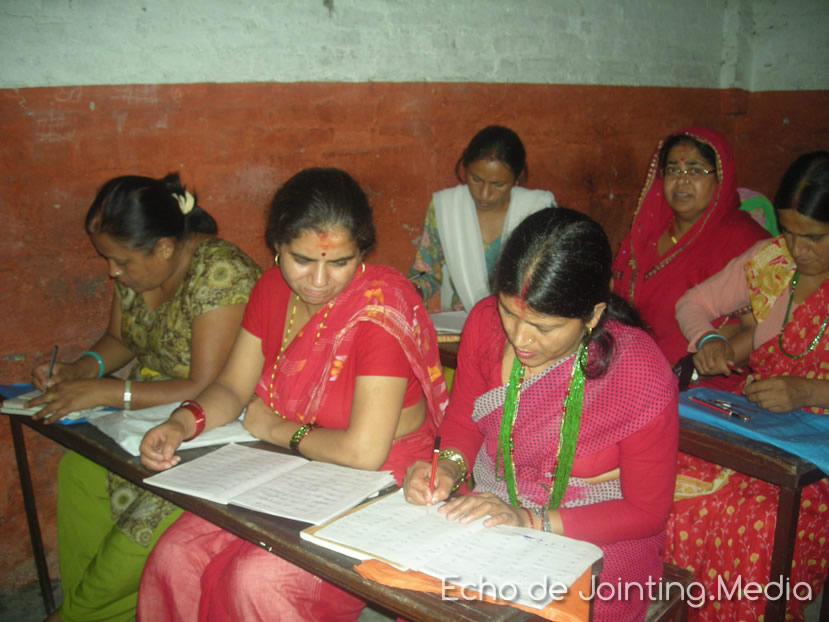
It was at Thamel Kathmandu where I first met Dhruba Ghimire. He and Uma, his wife, took one hour bus ride from Chabahil to pick me up. This tall thin man it’s the initiator of RUWON– Rural Women’s Network Nepal. Nowadays, hundreds of women in neighborhood take various classes of Nepali language, English, Mathematics, and Dance in Sagarmatham, a local primary school, from 5pm till 8pm, every Sunday till Friday.
RUWON, the organization which determines to evaluate the lives of the Nepali women, has been established for four years. Now it has two branches in Nepal: one in Sindhuli, Dhruba’s hometown and the other in the country’s capital, Kathmandu. Dhruba works full time in the organization, together with ten volunteers who forms the major staffs within both branches.
Canadian Tulip Festival
By Abdel Kabi in Ottawa, Jointing.Media 2010-05-15

We can’t be fragrant without water
We can’t be sunny without water
We will be wilted without water
We will become the stone without water
How could you decorate the capital of maple leaf at that time?
Calvin Chin: One can produce more value when engage in some tasks he himself is considering meaningful
By Jointing.Media in Shanghai, 2010-04-26
JM: Do you encourage students to go into the field of Social Enterprise? And Why?
Calvin Chin: Yes, I strongly encourage all undergraduates to consider SE. While each person has their own life pressures and may not be able to start a company. They can all consider joining an SE or volunteering for one. In fact, Qifang is always looking for young people to work with us, not only because we think they are smart, talented and bring a lot of good ideas, but also because we want to help encourage people to be social entrepreneurs. Why? Because while I think it is the most rewarding to be working on your own projects, to be working on something where you can really feel that the work that you do has meaning and can make a difference, this is even more the case when you are working on an SE. When you know that the work you are doing can make a difference for society, for our country, or even just for one individual or their family – that can inspire you to work your hardest, to be your best.
![[Recruiting 2011] Jointing.Media](http://jointings.org/eng/wp-content/themes/news-magazine-theme-640/cropper.php?src=/cn/wp-content/uploads/2012/06/123.png&h=50&w=50&zc=1&q=95)


