
【专栏】| Columnists > The Unconventional Server
By Jia, Jointing.Media, in Wenzhou , 2025-11-30
The so-called ‘Attention economy’ of our times essentially amounts to the trade of human ‘eyeballs’ as commodities. It is widely acknowledged that in this age, information floods in like a tidal wave, drowning people’s discernment and leaving them ever more shallow-minded. While no genuine gold can be found in this tide, some deliberately stir up waves at its crest, waiting for those ‘eyeballs’ to chase the surf before cramming in their tawdry wares, euphemistically termed ‘monetising traffic’. Yet such chaos is no mere incidental ‘moral decay.’ It stems from multiple ‘root causes’ festering and fermenting into this bitter fruit. Regulators, who ought to be the surgeons excising these root causes, often stand by as mere spectators or hangers-on, allowing the ‘monster’ to grow ever more rampant.
Looking back to the dawn of print media, when it first emerged, it still put on airs about ‘truth’ and ‘morality,’ at least draping a fig leaf over the ‘eyeball.’ But once radio waves and screens flooded the airwaves, that “eyeball” was swept along towards the ‘bustle’: First, sensationalist journalism stirred restless hearts; later, Super Bowl adverts filled the streets with the stench of money. Now, in the digital age, it’s even more astonishing: algorithms lurk like spectres, probing human preferences, trapping those eyes within tiny screens, feeding them fragmented scraps of leftovers, and calling it ‘personalised service’. Such tricks bear an uncanny resemblance to the old street monkey shows. Yet behind these ‘monkey-taming’ acts lie three deep-seated ills: the runaway pace of technology, the greed of capital, and the fragility of human nature. Regulators, who ought to be the gatekeepers, often linger outside the gate—either turning a blind eye or outright handing out passes, emboldening the monkey-taming charlatans to act with increasing impunity.
First, consider the technological frenzy. Herbert Simon’s observation that ‘information is abundant, attention is scarce’ was originally an inevitable consequence of technological evolution—printing enabled mass dissemination of information, electronic media fostered immersive communication, while digital technology decentralised and refined its precision. Yet technology itself is neither inherently good nor evil; it is those who wield it as a ‘harvesting tool’ who are at fault. Algorithms, born to enhance efficiency, are now used to construct ‘information silos,’ trapping people’s attention within narrow cognitive confines. Big data, designed to optimise services, is exploited for excessive user tracking, treating privacy as a ‘traffic password.’ At this juncture, regulators ought to establish ‘rules’ and define ‘red lines.’ Yet what do they do? Either they turn a blind eye to the ‘black box of technology,’ allowing algorithms to manipulate human attention in the shadows; or they issue regulations that merely scratch the surface, offering only ‘light warnings’ for traffic fraud and data abuse, never delivering a ‘heavy-handed crackdown.’ This regulatory inaction and sluggishness amounts to handing a ‘free pass’ to runaway technology, exacerbating the absence of ethical safeguards—constituting the first layer of indulgence in this chaotic landscape.
Then there is the greed of capital. The essence of the attention economy lies in monetising “attention” as a scarce resource, while the very nature of capital is to “pursue profit and shun loss”. When traditional industries see profits decline, capital swarms towards the ‘eyeball economy’ like sharks drawn to blood: platforms levy ‘commissions’ on traffic, creators exchange traffic for ‘tips’, and advertisers reap “profits” from traffic. Once this ‘traffic-driven interest group’ forms, it snowballs ever larger, treating ‘traffic supremacy’ as the sole ‘law of survival’. Regulators either lag behind, only patching holes after chaos erupts, or show bias—sparing major platforms while imposing draconian standards on small creators, thereby cementing top-tier monopolies. Worse still, the seemingly ambiguous relationship between regulators and capital breeds suspicion—why do penalties for false advertising and vulgar content always feel like scratching an itch through a shoe? Why do measures to address platforms’ traffic monopolies rarely strike at the root of the problem? Regulatory negligence and favouritism act as accomplices to the perversion of capital logic, emboldening greed to run rampant—this constitutes the second layer of indulgence enabling the chaos.
Finally, let us speak of the fragility of human nature. The collusion between technology and capital would ultimately fail to gain traction without human complicity—yet deep within the human heart lie three fears: the fear of loneliness, the fear of falling behind, and the fear of being uninteresting. Thus, social media’s ‘likes’ and “shares” become the elixir to fill the void of loneliness; ‘viral hits’ and ‘trending topics’ serve as proof of not being left behind; and ‘short, flat, and fast’ content acts as an anaesthetic to numb tedium. These three fears within the human psyche provide an opening for technology and capital to exploit. Regulators, who ought to be ‘awakening the public to clarity’ and guiding them towards sound values, often remain mere “bystanders”: they avoid discussing the dangers of ‘digital addiction’, remain indifferent to the trend of ‘shallow public discourse’, and turn a blind eye to the plight of ‘quality content lacking space to thrive’. This regulatory absence has amplified humanity’s fragility and deepened the loss of discernment – constituting the third layer of indulgence in this chaos.
These three root causes intertwine and reinforce each other, while the regulators’ triple indulgence has only emboldened the monster. Thus, industrial structures are distorted by ‘traffic’, public discourse is hijacked by “emotion”, and ‘heart and mind’ grow ever shallower in the ‘torrent of traffic’—can such chaos truly be summed up as mere ‘moral decline’? It is clearly the bitter wine brewed by technology, capital, and human nature, further laced with the ‘indulgence’ of regulators, rendering it ever more acrid and hard to swallow.
Today, calls for ‘media self-regulation’ and ‘platform accountability’ carry some merit. Yet unless regulators abandon their spectator stance and summon the courage to wield the scalpel, even the strictest self-discipline or most exemplary responsibility will remain mere talismans affixed to the monster—temporarily effective but ultimately failing to address the root cause. To cure this ailment, regulators must first engage in self-reflection: Regarding technology, they must establish ethical guidelines and enforce strict compliance standards, ensuring algorithmic transparency and lawful data usage while maintaining zero tolerance for violations. Regarding capital, they must establish boundaries of value and dismantle monopolistic structures, ensuring traffic monetisation coexists with societal value rather than prioritising traffic above all else. Regarding human nature, they must cultivate clear-headed discernment and foster an ecosystem of quality content. Through policy support, quality content must be given space to thrive, enabling the public to learn discernment through choice.
Yet rooting out these maladies proves far more arduous than chasing traffic. Regulators, largely custodians of the status quo, shy away from reform’s risks and fear offending vested interests. While the world surfs the waves, regulators stand by watching. How many dare become root-diggers? Well then, let us watch this ‘monster’ continue to devour our ‘eyeballs,’ and await the day when our ‘souls’ are utterly drowned. Only then might regulators realise that ‘traffic’ is but ‘fleeting smoke and clouds.’ Only by relinquishing “indulgence” and embracing ‘responsibility’ can we find the true path.
The moonlight is splendid tonight. I pushed open the window to gaze at the stars, only to be dazzled by the countless mobile screens in the building opposite. Those blue-tinged lights resembled innumerable hungry eyes.
Suddenly it dawned on me: the root of this ‘eyeball economy’ lies not in technology, nor in commerce, but in the barrenness of human hearts and the indulgence of regulators. Yet rousing these feigned sleepers may prove tenfold harder than weaning addicts off opium.
(This article was generated by Quark based on the author’s provided perspective)
Translated by DeepL
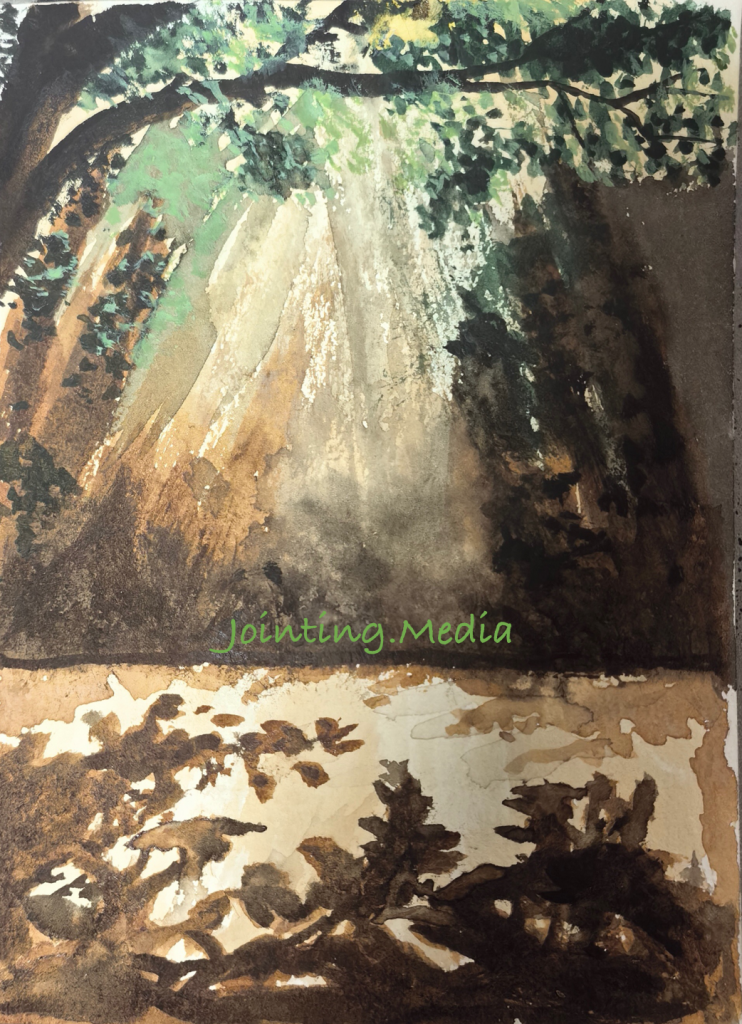
Painting by Ann | Morning Light in the Forest (2025)
Edited by Yiyi
![[Recruiting 2011] Jointing.Media](http://jointings.org/eng/wp-content/themes/news-magazine-theme-640/cropper.php?src=/cn/wp-content/uploads/2012/06/123.png&h=50&w=50&zc=1&q=95)


